All articles
GEIG 2027: existing non‑res need 1‑in‑10 chargers; residential renovations 50% pre‑wiring
From 1 January 2027, amended GEIG imposes 1 charger per 10 spaces or 50% ducting in existing non‑residential car parks with >20 spaces; residential ‘major renovations’ trigger 50% pre‑wiring. What owners of multifamily and mixed‑use assets should plan now.
What changes on 1 January 2027
Germany amended the Building Electric Mobility Infrastructure Act (Gebäude‑Elektromobilitätsinfrastruktur‑Gesetz, GEIG) via the 23 July 2026 amendment act that also renamed the Building Energy Act to the Building Modernisation Act (Gebäudemodernisierungsgesetz, GModG). Article 7 of that act revises GEIG with staged entry into force, including key duties from 1 January 2027. The legislative text is in Bundestag paper 21/6278 and was promulgated in the Federal Law Gazette on 28 July 2026 (BGBl. 2026 I No. 226). ([dserver.bundestag.de](https://dserver.bundestag.de/btd/21/062/2106278.pdf))
Existing non‑residential buildings with more than 20 parking spaces, either inside the building or adjacent to it, must ensure from 1 January 2027 either (a) one charging point for every tenth space or (b) at least 50% of both accessible and non‑accessible spaces are equipped with wiring ducts (“Leitungsinfrastruktur”) for e‑mobility. Public‑sector buildings used by authorities have a different requirement from 1 January 2033: at least 50% of spaces must have pre‑wiring (“Vorverkabelung”). ([dserver.bundestag.de](https://dserver.bundestag.de/btd/21/062/2106278.pdf))
For residential buildings, a “major renovation” triggers pre‑equipment duties once the building has more than three parking spaces. In that case, at least 50% of both accessible and non‑accessible spaces must be pre‑wired, and the remaining spaces must receive ducting. There is no mandatory number of charging points in this residential‑renovation trigger. “Major renovation” is defined as works affecting more than 25% of the building envelope area. ([dserver.bundestag.de](https://dserver.bundestag.de/btd/21/062/2106278.pdf))
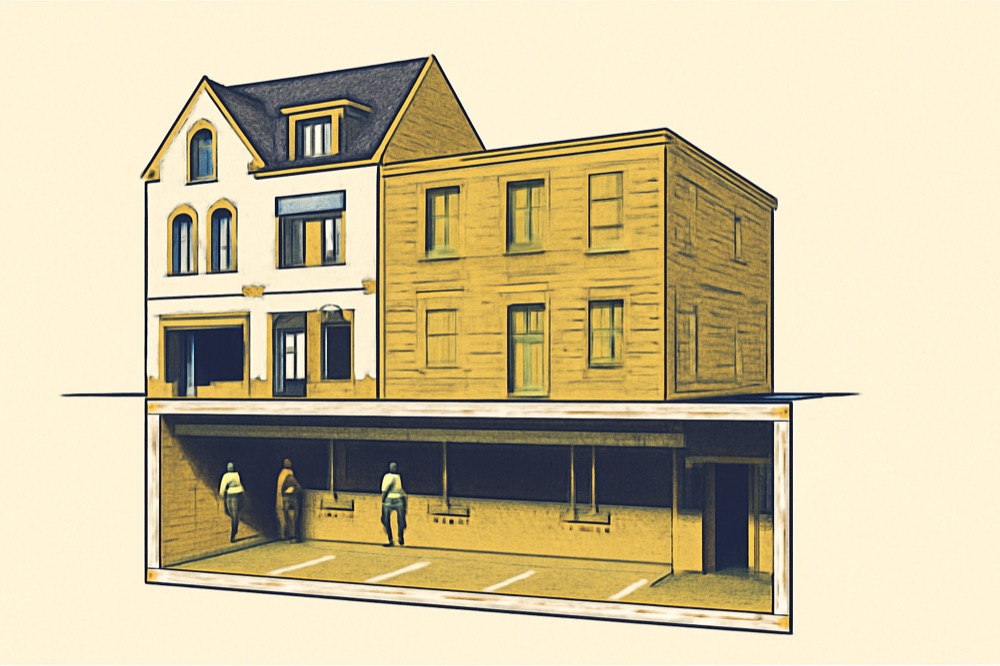
For mixed‑use buildings, GEIG applies to existing assets with more than 10 total spaces (inside or adjacent). The obligations for all spaces then follow the building’s predominant use (residential vs non‑residential). ([umwelt-online.de](https://www.umwelt-online.de/regelwerk/gefahr.gut/strasse/geig21.htm))'}},{
Key definitions you will need
Ducting (“Leitungsinfrastruktur”) means the set of conduits to accommodate future power and data cabling from each space to the user’s meter and protection devices. Pre‑wiring (“Vorverkabelung”) goes further: it includes data and power cabling and ends at a connectable endpoint at each space (for example a junction box) so that a charger can be connected without further electrical works. The law also requires that the 50% calculation cover accessible and non‑accessible spaces evenly. ([umwelt-online.de](https://www.umwelt-online.de/regelwerk/gefahr.gut/strasse/geig21.htm))
“Major renovation” for GEIG purposes means a renovation where more than 25% of the surface of the building envelope is renovated. ([umwelt-online.de](https://www.umwelt-online.de/regelwerk/gefahr.gut/strasse/geig21.htm))
Alternative compliance routes exist. If the spaces are publicly accessible, an owner may satisfy the duty by installing publicly accessible charging capacity in total equal to the number of publicly accessible spaces multiplied by 1.1 kW (for the existing‑non‑residential duty under § 10). For new builds and renovations under §§ 7 and 9 a higher 2.2 kW factor applies. ([dserver.bundestag.de](https://dserver.bundestag.de/btd/21/062/2106278.pdf))
Scope, exemptions and enforcement
GEIG does not apply to non‑residential buildings owned and predominantly used by SMEs as defined by the EU SME Recommendation. There are transitional rules, and the “cost cap” for renovation‑triggered duties rises to 10% of total renovation costs from 1 January 2027 (previously 7%). Where the cap is exceeded, §§ 8–10 do not apply. ([umwelt-online.de](https://www.umwelt-online.de/regelwerk/gefahr.gut/strasse/geig21.htm))
If an owner installed the earlier “at least one charger” requirement for an eligible existing non‑residential building between 27 May 2022 and 27 May 2024, § 10 may be deferred for that site until 1 January 2029. ([umwelt-online.de](https://www.umwelt-online.de/regelwerk/gefahr.gut/strasse/geig21.htm))
Owners with multiple buildings can pool the number of chargers required under § 10 across their portfolio if a plan across all affected sites reflects existing or expected demand; the plan must be presented to the authority on request. ([umwelt-online.de](https://www.umwelt-online.de/regelwerk/gefahr.gut/strasse/geig21.htm))
Breaches are administrative offences punishable by fines up to €10,000, including failures to meet the 1‑in‑10 charger rule or the 50% equipment rule where applicable. ([umwelt-online.de](https://www.umwelt-online.de/regelwerk/gefahr.gut/strasse/geig21.htm))
Capex planning for multifamily and mixed‑use assets
Start with a parking inventory by building: count inside and adjacent spaces separately because GEIG counts these separately when testing thresholds; document how many are barrier‑free. For mixed‑use, determine the predominant use of the building because that controls which rule applies to all spaces. For residential schemes, check whether planned works meet the “major renovation” definition (more than 25% of the envelope). ([dserver.bundestag.de](https://dserver.bundestag.de/btd/21/062/2106278.pdf))
Decide your compliance path. In existing non‑residential stock with >20 spaces you can choose (a) chargers for 10% of spaces or (b) ducting to 50% of spaces. Publicly accessible car parks have the option to comply via total public charging capacity of 1.1 kW per public space. Portfolio owners may pool chargers across sites with a documented plan. ([dserver.bundestag.de](https://dserver.bundestag.de/btd/21/062/2106278.pdf))
Establish network capacity and timelines with the distribution system operator early. The government’s impact assessment attached to the bill estimates typical unit costs used for modelling: approximately €1,045–€5,200 per charger (mean €2,440), around €600 per space for ducting, and about €400 per space for pre‑wiring. Real projects vary widely; use them only as ballpark inputs for budgets and sensitivity tests. ([dserver.bundestag.de](https://dserver.bundestag.de/btd/21/062/2106278.pdf))
Mitigate load and capex with load‑management and phased roll‑out. Pre‑wiring 50% of spaces in residential renovations can be combined with staged charger installation as tenant uptake grows. Ensure contractor “declarations of compliance” (Unternehmererklärung) are collected and retained for five years; authorities may ask for plans and documentation. Engage an electrical designer (TGA‑Planer), your grid operator, and a German construction lawyer for contract wording; do not rely on informal interpretations. ([umwelt-online.de](https://www.umwelt-online.de/regelwerk/gefahr.gut/strasse/geig21.htm))
Timeline to act (today is 20 September 2026)
- Q4 2026: Complete site surveys, pick compliance route, and submit early grid‑capacity requests. Where tendering is needed, fix scopes that reflect GEIG’s 50% pre‑wiring language and the distribution across accessible and non‑accessible spaces. - By 1 January 2027: Existing non‑residential >20‑space sites should be ready to execute either 1‑in‑10 chargers or 50% ducting. Residential projects entering “major renovation” after this date must budget for 50% pre‑wiring and the remainder ducting. - 2027 onward: For publicly accessible car parks, consider whether the 1.1 kW‑per‑space capacity route is more efficient. Keep portfolio‑level plans updated for any pooling under § 10(3). Non‑compliance risks fines up to €10,000. ([dserver.bundestag.de](https://dserver.bundestag.de/btd/21/062/2106278.pdf))
Nothing on this page is investment, tax or legal advice. Price bands are indicative asking prices and disagree between sources by design. Verify every figure with a qualified German notary, tax adviser (Steuerberater) or lawyer before committing capital.