All articles
How the federal “Wärmenetz” Eckpunkte (26 Aug 2026) and municipal heat‑planning maps change service‑charge risk in Munich, Frankfurt and Hamburg
What the federal Eckpunkte of 26 Aug 2026 changes, how to use municipal heat‑planning maps to check an address in Munich, Frankfurt and Hamburg, and what the typical service‑charge risks are for buyers and investors.
What the federal Eckpunkte of 26 Aug 2026 say — the narrow fact
On 26 August 2026 the Federal Government published Eckpunkte for a Wärmenetzpaket that the Federal Ministry for Economic Affairs presented to the Cabinet. The stated aim in the ministry press material is to speed up and simplify the expansion of urban heat networks and to prepare a new Wärmenetzgesetz that will set the legal framework for that expansion. The document is an outline of measures and does not itself change municipal heat plans; it intends to create national rules that will guide further legislation and municipal implementation. ([bundeswirtschaftsministerium.de](https://www.bundeswirtschaftsministerium.de/Redaktion/DE/Pressemitteilungen/2026/08/20260826-eckpunkte-waermenetzpaket.html?utm_source=openai))
What municipal heat‑planning maps show and why that matters for service charges
Since the Wärmeplanung obligation is implemented at municipal level, Munich, Frankfurt and Hamburg publish planning maps that show (a) where existing district heat is available, (b) where the city considers district heat suitable or desirable under its target scenario, and (c) where decentralised solutions (heat pumps, individual systems) are preferred. Hamburg provides an interactive Wärmeportal with a target‑scenario map that lets you test an address and see which supply option is technically and economically preferable. Munich publishes its Wärmeplan and an interactive geoportal page with maps of Wärmeversorgungsgebiete (status December 2025 noted on the city pages). Frankfurt makes available a mapped inventory of its heat supply areas (city energy management PDF). These municipal maps are the primary source to assess the likelihood that a given address will be connected to a heat network in the coming years. ([hamburg.de](https://www.hamburg.de/politik-und-verwaltung/behoerden/bukea/themen/energie/kommunale-waermeplanung/waermeportal-hamburg/waermeportal-1149902?utm_source=openai))
How planned district‑heat conversion alters service‑charge risk — practical implications
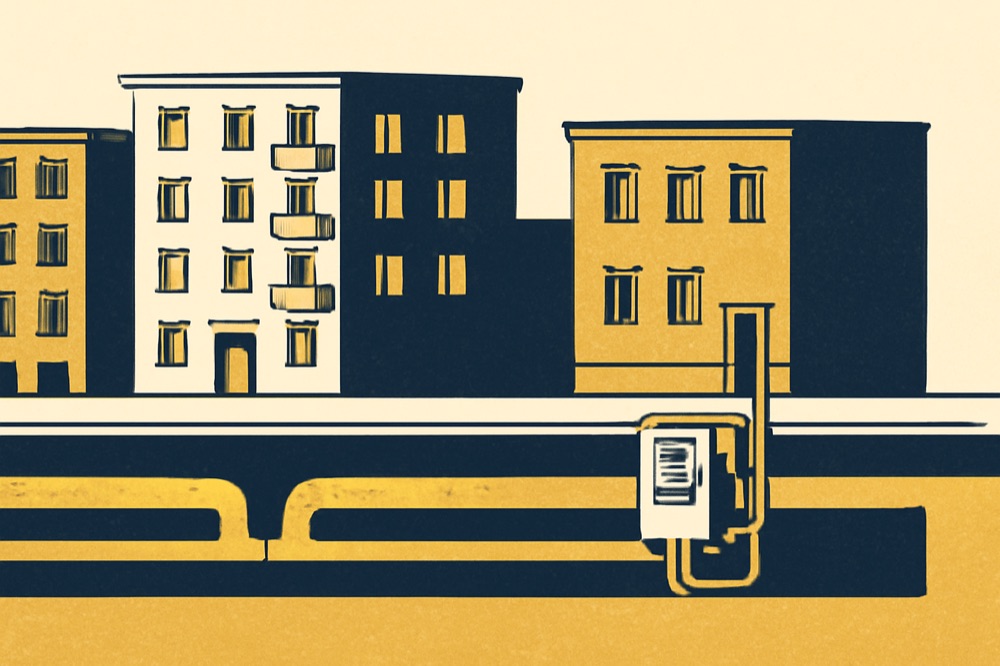
If a property sits inside a municipal target area for district‑heat expansion, investors face three real risks to future operating costs: (1) higher recurring charges: district‑heat tariffs and billing mechanics differ from individual gas or oil systems and can change annual operating‑cost profiles; (2) contractual exposure: when a network is built, owners may be offered or required by local rules to accept a network connection and a district‑heat contract with a network operator — the tariff structure and indexation clause in that contract determine future service‑charge volatility; (3) capital/retrofit cost and timing: the building may need changes (substation, pipe routes) that an owner must finance or amortise through the unit operating budget. Municipal maps do not themselves set tariffs, but they materially raise the probability that one of these risks will arise for properties shown as suitable for network expansion. (The maps and the federal Eckpunkte together make the likelihood of coordinated expansion clearer; the Eckpunkte are the federal steer, the city maps are the address‑level indicator.) ([bundeswirtschaftsministerium.de](https://www.bundeswirtschaftsministerium.de/Redaktion/DE/Pressemitteilungen/2026/08/20260826-eckpunkte-waermenetzpaket.html?utm_source=openai))
A simple checklist to check an address today
1) Look up the address in the municipal heat map: Hamburg’s Wärmeportal supports address queries; Munich’s geoportal lists Wärmeversorgungsgebiete (see city pages); Frankfurt’s energy‑management PDF shows network zones. ([hamburg.de](https://www.hamburg.de/politik-und-verwaltung/behoerden/bukea/themen/energie/kommunale-waermeplanung/waermeportal-hamburg/waermeportal-1149902?utm_source=openai))
2) If the address falls into a target/expansion zone, request the planned timeframe and the responsible network operator from the city energy office (the map pages give operator lists or project contacts). Use that operator name to find standard tariffs and any price‑transparency pages they publish.
3) Ask the seller for recent heating bills, the current heating‑system specification, and any correspondence with municipal energy planners or network operators.
4) Before closing, instruct counsel or an energy consultant to review sample district‑heat contract terms (indexation, minimum consumption, takeover clauses) and to model the impact on annual operating costs under realistic tariff increases.
These are procedural steps based on the municipal map functionality and the federal steering document; they are the practical way to turn the address‑level maps into an investor risk assessment. ([hamburg.de](https://www.hamburg.de/politik-und-verwaltung/behoerden/bukea/themen/energie/kommunale-waermeplanung/waermeplan-fuer-hamburg-beschlossen-1177396?utm_source=openai))
What this means for foreign buyers and investors — plain language
The Eckpunkte of 26 Aug 2026 increase the probability that cities will pursue coordinated heat‑network expansion. For a buyer this means: check the municipal heat map for the address and, where a network is planned, assume higher uncertainty in future operating costs until you have seen draft tariffs and contract terms. Don’t rely on a verbal assurance from a seller; use the map, request operator tariffs, and have a lawyer or energy consultant check sample district‑heat contracts before purchase. This article does not give legal or tax advice — for contract review, ask a German energy lawyer or a specialist technical consultant. ([bundeswirtschaftsministerium.de](https://www.bundeswirtschaftsministerium.de/Redaktion/DE/Pressemitteilungen/2026/08/20260826-eckpunkte-waermenetzpaket.html?utm_source=openai))
Nothing on this page is investment, tax or legal advice. Price bands are indicative asking prices and disagree between sources by design. Verify every figure with a qualified German notary, tax adviser (Steuerberater) or lawyer before committing capital.