All articles
Germany’s permit rebound in May–July 2026: what it means for 2027/28 completions in Berlin, Hamburg, Munich and Cologne
Destatis reports y/y permit gains in May (+24.7%), June (+13.8%) and July (+1.9%) 2026. With a 26‑month average build time, most effects show in 2028; 2027 relief will be modest and city‑specific.
What turned in May–July 2026
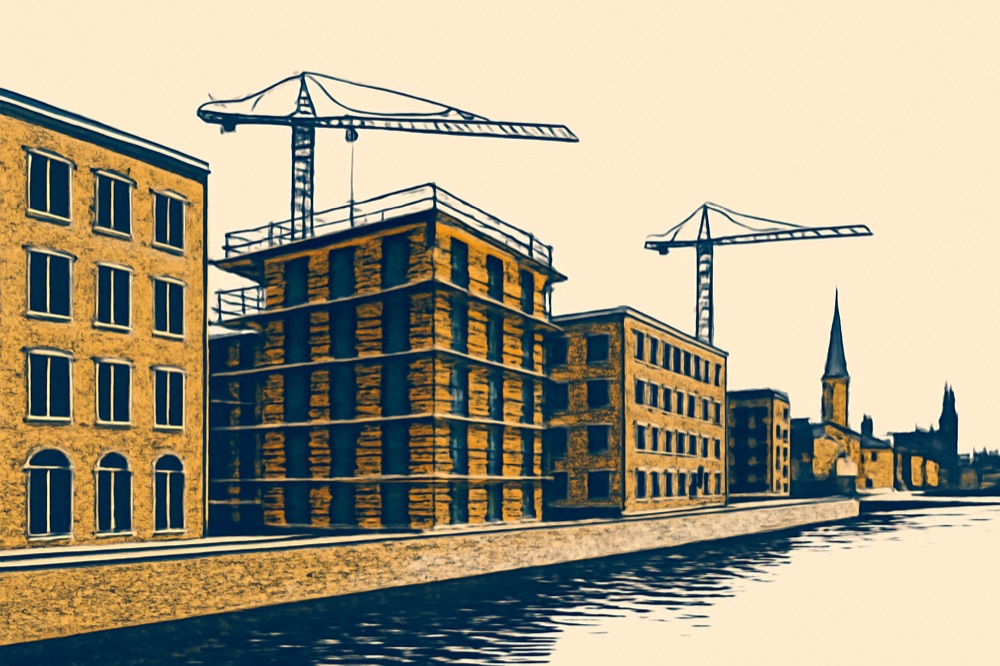
Germany’s housing permits clearly turned up in mid‑2026. Destatis reported +24.7% year‑on‑year in May 2026 (21,000 dwellings), +13.8% in June (21,600), and +1.9% in July (22,500). June’s press release (Press release no. 291, 18 August 2026) also confirmed the strongest first‑half rise in permits since 2016, with 126,300 dwellings permitted in H1 2026, +15.1% y/y. July’s release (no. 330, 18 September 2026) showed the uptrend still intact. Destatis cautions that monthly totals are affected by late reports (Nachmeldungen), so month‑to‑month noise is normal.
Crucially for big cities, the rebound is led by multi‑family housing. In January–July 2026, permits for new dwellings in multi‑family buildings rose by around +15% y/y nationwide (79,700 dwellings of 121,200 in new residential buildings). That mix matters because apartments in multi‑family buildings typically take longer to deliver than single‑family homes.
How permits translate into completions
Permits do not add supply immediately. Destatis reports the average time from permission to completion (“Abwicklungsdauer”) for homes finished in 2024 rose to 26 months (from 24 months in 2023 and 20 months in 2020). Earlier analysis of multi‑family completions shows a wide spread: in 2019, only about a quarter of multi‑family projects finished within 18 months, while roughly a third took 30 months or longer. This is consistent with what we see today in dense urban builds.
Implication: dwellings permitted in May–July 2026 will mostly appear in completion statistics from late 2027 through 2028, with the bulk likely in 2028. Single‑family or modular projects can surface sooner; complex multi‑family schemes tend to be on the longer side.
Two further caveats matter for forecasting: (1) permits can lapse if work does not start within the time limits set in each Land’s building code (for example § 73 HBauO in Hamburg and § 73 BauO Bln in Berlin provide for validity and extensions); and (2) the sector’s capacity and financing conditions shape the pace. Orders and employment in the civil engineering core remain supportive as of mid‑2026 (June 2026: building sector employment +1.5% y/y).
Berlin: long multi‑family pipeline, 2028 impact largest
Completions held up in 2024: Berlin reported 15,362 finished dwellings (press release no. 70, 19 May 2025). Of these, 14,632 were new‑build and 13,637 were in multi‑family buildings—evidence of the capital’s multi‑family dominance. The stock of approved but not yet completed homes (the “Bauüberhang”) at end‑2024 is reported in a range of 49,554 to 50,408 dwellings by official sources that differ in cut‑off and method. Berlin also saw a sharp permit recovery in 2025 to 14,079 dwellings (+44.1% y/y), which pre‑loads completions for 2027/28.
Putting the pieces together: with a 26‑month average build time and a multi‑family heavy mix, Berlin should see only limited relief in 2027 from the mid‑2026 permit bounce; the main wave should register in calendar 2028. The size of the 2024‑vintage backlog provides a buffer—if developers can move schemes from “under roof” to finish without financing or cost shocks.
Hamburg: completions surged in 2024; 2028 looks set to benefit most
Hamburg’s completions rebounded strongly in 2024 to 8,319 dwellings (+39% vs. 2023, Statistikamt Nord). That momentum cushions 2025–2026 deliveries, while the national permit upswing in mid‑2026 should feed into Hamburg’s pipeline on a roughly 2028 timetable given typical urban build times. Statistikamt Nord tracks the city’s Bauüberhang and build stages; the published series indicates a persistent backlog that can convert to completions if financing and contractor capacity hold. Expect modest 2027 relief and a clearer 2028 impact in multi‑family hotspots such as HafenCity and the inner districts.
Munich: large backlog, slow‑burn multi‑family delivery
Munich completed 6,501 dwellings in 2024 (Statistisches Amt München, city table of completions). The backlog is large: at end‑2024 the city recorded roughly 28,600 dwellings in the residential Bauüberhang, distributed across “not yet started”, “under construction”, and “under roof” stages. Given high multi‑family shares and site complexity, Munich tends to a longer build cycle. The mid‑2026 permit upswing therefore points to a modest effect in late‑2027 and a more visible push through 2028, assuming stable contractor availability and finance.
For buyers tracking new‑build delivery in the western and northern districts with major projects in the pipeline, the backlog composition—how much is already “under roof”—is the best near‑term indicator for 2027 handovers.
Cologne: 2024 slump, but a backlog to draw from
Cologne’s completions fell sharply in 2024 to 1,819 dwellings (–48.5% y/y; City of Cologne press release), and the city notes a resulting increase in the Bauüberhang. Earlier statistical bulletins show that in recent years the multi‑family backlog hovered around 7,000 dwellings. With a 26‑month national average build time and Cologne’s multi‑family focus in inner districts, the mid‑2026 permit upswing is more likely to lift 2028 than 2027 completions. Watching quarterly updates from the city’s statistics office—especially the split of the backlog by build stage—will help identify which schemes can realistically deliver in 2027.
Permits can lapse if not started within the validity set by North Rhine‑Westphalia’s building code (BauO NRW); extensions are possible case‑by‑case. Developers therefore have an incentive to move faster on already‑designed projects as financing terms stabilise.
Investor checklist for 2027/28
- Expect only modest new‑build relief in 2027 in the four A‑cities; the 2026 permit rebound mainly feeds 2028. - Track each city’s Bauüberhang by build stage. Berlin (c. 50k units end‑2024) and Munich (c. 28.6k units end‑2024) have buffers that can convert to completions. - Multi‑family dominates: Berlin’s 2024 new‑build completions were 93% in multi‑family buildings. Nationwide Jan–Jul 2026, multi‑family accounted for roughly two‑thirds of new dwellings permitted. - Permits can lapse; check state building‑code validity and extension rules before underwriting project timelines. - This article is not legal, tax or investment advice. For project‑specific questions, consult a Fachanwalt für Bau‑ und Architektenrecht and a local Projektsteuerer.
Nothing on this page is investment, tax or legal advice. Price bands are indicative asking prices and disagree between sources by design. Verify every figure with a qualified German notary, tax adviser (Steuerberater) or lawyer before committing capital.