All articles
BEG 21 July 2026: 5% serial-renovation bonus added for EH70 EE
Germany extended the BEG serial‑renovation bonus to EH70 EE on 21 July 2026. Applications are expected from late September 2026. What changed and what foreign buyers must prepare.
What changed on 21 July 2026
The Federal Funding for Efficient Buildings (BEG) was amended with effect from 21 July 2026. For full building renovations (KfW system programmes), KfW now recognises only EH40/55/70/85 and Denkmal, each as EE or NH class. At the same time, the 5 percentage‑point add‑on for EE class was abolished and all standard repayment‑bonus rates were cut by 10 percentage points across BEG WG (residential) and BEG NWG (non‑residential). KfW confirmed these changes in its consolidated BEG update page and in press material published on 21 July 2026.
New: 5% serial‑renovation bonus now also at EH70 EE
Until now, the serial‑renovation (SerSan) bonus applied only when a serially renovated residential building reached EH40 or EH55, in which case it increased the repayment bonus by 15 percentage points. From 21 July 2026, KfW extends the SerSan bonus to serial refurbishments that reach EH70 EE. In that case, the add‑on is 5 percentage points. KfW states that applications for this extended bonus are expected to be possible from the end of September 2026. The technical Infoblatt (Version 11.0, in force since 16 September 2026) specifies that application for the (new and extended) SerSan arrangements is possible from 24 September 2026.
How the serial‑renovation pathway is defined
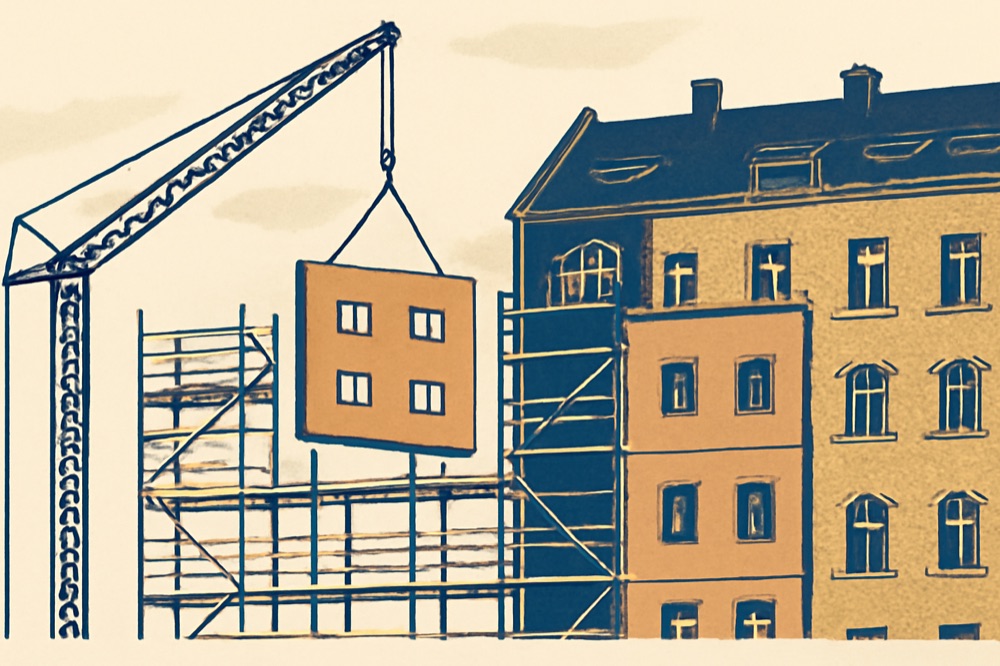
KfW’s Infoblatt (Version 11.0) sets minimum conditions specific to serial refurbishment. The facade must be renovated with serial, factory‑made elements based on a digital 3D survey. At least 80% of exterior‑air‑exposed facade areas (either the heat‑transmitting facade or the entire facade) must be covered with these prefabricated elements. The elements must be installed on site unchanged in size and form, and—where window replacement is required—windows or frames must be pre‑integrated into the elements at the factory. Element height must at least match floor‑to‑ceiling height; elements just below roof overhangs are exempt from the height rule. These technical points must be reflected in the expert confirmations that accompany your application and completion.
Who can apply and through which programme
Residential full renovations (BEG WG) are financed via KfW’s “Wohngebäude – Kredit (261)”. Applicants include private individuals, homeowner associations (WEGs), companies and other legal persons. The property’s original building application or notice must be at least five years old at the time of application. If you buy a freshly renovated property, the renovation costs must be itemised separately (e.g., in the purchase contract) to qualify. The repayment bonus is credited after completion. A 10% extra repayment bonus is available for Worst‑Performing Buildings (WPB) when the WPB criteria are met. KfW confirms that serial‑renovation bonuses are combinable with WPB and with the NH class, while the separate 5% EE‑class add‑on was removed on 21 July 2026.
When you can apply
KfW indicates that applications for the extended EH70 EE serial‑renovation bonus are expected from the end of September 2026. The technical Infoblatt 11.0 states that the application channel for the new and extended SerSan rules opens on 24 September 2026. Plan your contract timing around this. Do not sign implementation contracts before you have applied unless you use a suspensive or resolutory condition appropriate for KfW lending. Your financing partner (bank) files the KfW 261 application based on a “Bestätigung zum Antrag” (BzA) prepared by your energy‑efficiency expert.
Document checklist for non‑German buyers
KfW does not restrict nationality; what matters is the building, the renovation path and the application process. As a non‑German buyer or investor, prepare these items early:
- Energy‑efficiency expert engagement and BzA. You must involve a German‑listed energy‑efficiency expert. The BzA is mandatory for KfW system renovations and is the document your bank needs to submit your 261 application.
- Serial‑renovation evidence. Your designer/manufacturer should document the serial facade approach: digital 3D survey deliverables, system specifications, coverage calculation proving at least 80% exterior‑air‑exposed facade area with prefabricated elements, factory integration of windows/frames if applicable, and plans showing element heights. These points must appear in the BzA and later in the BnD (completion confirmation).
- EE‑class and target standard. For EH70 EE, coordinate with your expert on how the renewable‑energy criteria for the EE class are met within the renovation scope; this must be reflected in the energy balance and in the BzA/BnD. If you buy a freshly renovated property, ensure the renovation costs are separately itemised in the notarised purchase contract.
- Quotes and conditional contracts. Collect detailed contractor offers. If you need to sign before the KfW application, use suspensive/resolutory clauses acceptable under KfW rules.
- If you own in a WEG. Obtain a formal owners’ resolution authorising the renovation and the KfW application; KfW requires the relevant WEG decisions.
- Bank onboarding (KYC/AML). Your financing partner will identify you under Germany’s anti‑money‑laundering law (GwG)—typically via passport or other acceptable ID—and will obtain a tax‑residency self‑certification (FKAustG/CRS). Allow extra time if you are non‑resident. For KfW’s (now‑closed) grant portal the KfW also referenced identity checks; banks apply similar AML requirements when forwarding loan applications.
Practical steps and pitfalls
- Sequence. Engage your energy‑efficiency expert first; draft the measures to reach EH70 EE via serial refurbishment; produce the BzA; then approach a financing partner to submit the KfW 261 application. Do not start implementation early unless your contracts are properly conditional.
- Timeline. The SerSan application path for EH70 EE opens on 24 September 2026 per KfW’s Infoblatt. KfW also flagged “end of September 2026” in programme updates. Budget‑availability warnings still apply; there is no legal entitlement.
- Combining bonuses. SerSan is combinable with WPB and with the NH class. The separate 5% EE‑class add‑on no longer exists. For precise combined caps, rely on the current KfW Merkblatt/Infoblatt at the time you file; historic materials capped combinations, and the ministry signalled adjustments to the SerSan–WPB interplay.
- Technical compliance. Serial‑element coverage, element height, factory integration of windows and the digital survey are audited points. Falling short risks losing the SerSan add‑on at completion.
- Purchase of a refurbished asset. Ensure the notarised contract splits the renovation consideration; otherwise the KfW cannot attribute eligible costs to the BEG renovation.
Nothing on this page is investment, tax or legal advice. Price bands are indicative asking prices and disagree between sources by design. Verify every figure with a qualified German notary, tax adviser (Steuerberater) or lawyer before committing capital.